
I was recently talking to my boat mechanic. I asked him about the hardest problems he faces. He gave me a very complex electrical issue on a large boat, something that normally takes hours of troubleshooting. Within seconds, ChatGPT and Claude nailed the diagnosis. He looked at me, realized the machine had taken away the toughest part of his job, and immediately saw what it meant: higher throughput, faster turnaround, more competition. Intelligence was no longer the bottleneck.
Not long after, I was at a fine dining restaurant and asked the chef for the recipe behind a remarkable entrée. He smiled, because that recipe used to be his edge. But today AI can generate, refine, and even optimize recipes for taste and cost. The chef’s real advantage isn’t the recipe anymore—it’s how the kitchen runs under pressure, the authenticity of the dining experience, and the human connection around the plate.
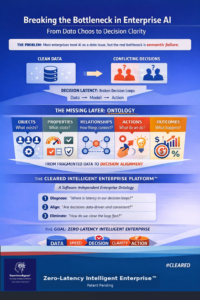
These day-to-day stories transfer directly to what’s happening inside companies. Intelligence has been commoditized. Search commoditized information. AI has commoditized intelligence. The scarce resource is no longer analysis or knowledge. It’s judgment. It’s orchestration. And this is happening today, not in some distant future.
Decision throughput is now 5x to 10x faster. Like my mechanic discovered, when intelligence bottlenecks are removed, throughput explodes. At the enterprise level, decisions that once took weeks of analysis and debate can now be informed in hours or even minutes. The challenge isn’t speed anymore. The challenge is governance: which decisions to trust, which to gate, and how to embed judgment into the flow.
In this new anatomy of the AI-Enabled™ Enterprise, roles and behaviors are transformed:
At the board level: Market scans, strategy decks, and competitive analyses are instantly generated. The board’s role is no longer to debate the inputs, but to orchestrate, deciding which bets to gate, how much capital to allocate, and what risk thresholds are acceptable.
On the production floor: Supervisors no longer chase raw reports. AI systems highlight anomalies and trigger insights in real time. The human role is to orchestrate, synchronizing teams, sequencing responses, and ensuring actions align with broader goals.
This is the rise of the orchestrator. Like a conductor in front of an orchestra, leaders must align humans, AI systems, and operating models into a coherent performance. Intelligence is the instrument, cheap, abundant, available to all. Orchestration is the differentiator, rare, valuable, and decisive.
The shift is not incremental, it’s structural. Intelligence is now a commodity. The differentiator is orchestration: how boards set gates, how capital is allocated, how frontline teams act on AI-driven insight. This is the anatomy of the AI-Enabled™ Enterprise. Treat it as a set of isolated projects and you will sub-optimize. Approach it holistically, as a redesign of how the enterprise thinks and behaves, and you create durable advantage.
That’s exactly why I’ve been building CLEARED AI™, a framework designed to turn this orchestration into a repeatable operating model. I haven’t formally introduced it yet, I promised that by the end of September, but this shift is why it matters. If intelligence is now cheap, the only way forward is to embed judgment, probability, and gates into the anatomy of the enterprise. CLEARED AI™ is built for that.
The CLEARED AI Framework and approach will be released soon….