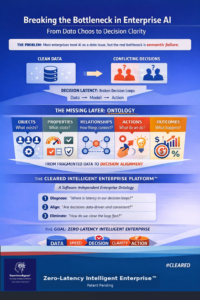

A respected voice in the data world recently made a sharp observation: BI semantic layers are not the same as agentic semantic layers. She is right. But there is a third layer most enterprises are missing entirely, and it is the one that determines whether any of this produces results.
The enterprise data stack has never been better. Cloud warehouses. Data catalogs. Governed metrics layers. Knowledge graphs with context and memory. Query generation engines that translate business questions into structured outputs. The semantic problem, the long nightmare of systems that could not agree on what “customer” or “asset” or “inventory” meant, is finally being solved at the platform level.
And yet enterprise AI transformation still fails at rates above 70 percent. Boards still cannot explain where the value went. Executives still make consequential decisions on instinct because the system, despite all of its semantic richness, does not tell them what to do next.
The problem is not the data layer. The problem is the layer above it.
Three Layers. Most Enterprises Have Two.
LAYER 1
BI Semantic Layer
Makes data consistent and queryable. Solves the meaning problem for analytics. Powers dashboards and reports. Stops at insight.
LAYER 2
Agentic Semantic Layer
Adds context, memory, and knowledge graphs so AI agents can reason across domains. Moves from query to generation. Still stops before execution.
LAYER 3 — MISSING
Decision Ontology
Defines what decisions exist, who owns them, what triggers them, what actions they generate, and how outcomes close the loop. This is where value is either captured or lost.
Most enterprises are investing heavily in layers one and two. They are building beautiful semantic infrastructure. And then they wonder why the insights sit in dashboards rather than flowing into action.
The answer is that semantic alignment solves the data problem. It does not solve the decision problem. And in the enterprise, the decision problem is where the money is.
What the Decision Problem Actually Is
Every enterprise runs on decisions. Not strategies. Not reports. Decisions. Should we rebalance inventory across facilities? Should we escalate this production shortfall now or absorb it? Should we accept this order given current fulfillment capacity? These decisions happen thousands of times per day, across every function, at every level.
In most enterprises, these decisions share a common failure pattern. The data exists. The model exists. The insight has been generated. And then a human opens a spreadsheet, sends an email, waits for a reply, and makes a judgment call based on a combination of the data and whatever experience and instinct they brought to work that morning.
That gap between insight and action is decision latency. It is not a technology problem. It is an architecture problem. The enterprise has never formally defined its decisions.
The data knows what is happening. The enterprise does not know what to do about it. That gap is structural, not operational. You cannot close it with more data or better models. You close it by defining the decision itself.
What a Decision Ontology Does
A decision ontology defines the enterprise as an executable system. It answers the questions that data platforms and semantic layers do not ask.
What decisions exist in this enterprise? Who owns each one? What conditions trigger it? What data must be present before it can be made? What action does it generate when executed? Who is accountable for that action? How do outcomes feed back to improve the next decision?
When these questions are answered at the architecture level, rather than the use-case level, the enterprise can begin to close decision loops automatically. Not because the AI is making the decisions, but because the system is designed so that when a trigger fires, the right information reaches the right owner, the action pathway is clear, and execution is tracked.
THE DECISION LOOP
Trigger→Decision→Action→Outcome→Feedback
This loop is not new. Every enterprise already runs on it. What is new is making it explicit, governed, and measurable. When the loop is defined, it can be accelerated. When it is accelerated, decision latency drops. When decision latency drops, the enterprise converts its AI investment into operational performance rather than operational overhead.
Why This Has Not Been Done
The honest answer is that decision architecture was never anyone’s job. Data architecture has a discipline, a profession, a toolset. Process architecture has the same. AI architecture is rapidly developing its own. But who in the enterprise is responsible for defining what decisions exist, who owns them, and how they close?
In most organizations, no one. Decisions are implicit. They live in the heads of experienced people, in the norms of functional teams, in the unwritten rules of escalation. When those people leave, the decision logic leaves with them. When AI is deployed, it inherits the same ambiguity. It generates recommendations into a vacuum because the ownership and action pathway were never defined.
The semantic layer made the data legible. The decision ontology makes the enterprise executable.
The Competitive Implication
Intelligence is being commoditized. Foundation models are improving faster than any enterprise can build bespoke advantage on top of them. The data and semantic layers that took years to build are being replicated in months by competitors with better tooling and larger budgets.
The durable advantage is not in the model. It is in how quickly the enterprise can convert a signal into a decision and a decision into an action. That speed is determined entirely by how well the decision layer is designed.
Enterprises that define their decision ontology now will compound that advantage as AI capability improves. Enterprises that continue to treat decisions as implicit will find that better models simply generate better insights that still sit in dashboards.
The future of enterprise AI will be determined by decision architecture, not model capability. The question is not which model you are running. It is how fast your loops close.
Where to Start
The most common mistake is treating decision architecture as a future-state goal. Build the data layer first. Build the semantic layer. Then add the decision ontology later. This sequence does not work. Every decision loop built without a governing ontology creates its own semantic contract. When the ontology is eventually introduced, every existing loop must be redesigned.
The correct sequence: define the decision ontology framework before the first use case is deployed. Not in full, but in enough scope to govern the first set of loops. Extend it as each new use case adds new decision types, new owners, and new action pathways. The ontology is not a project with an end date. It is a governance practice that begins on day one.
The enterprises that will win the next decade of AI transformation are the ones building this layer now. Not because they have better data or better models, but because when the signal fires, their system knows exactly what to do with it.