Clarify the Leadership Architecture
After leading seven CIO and CTO roles — from NASA simulators to global industrials, I’ve seen the same pattern repeat: when technology evolves faster than organizational design, leadership fragments.
Enterprises are now drowning in titles — CIO, CTO, CDO, CAIO, CVO, CDAO, each owning a piece of “digital,” “data,” or “AI.” The outcome is governance confusion, not leadership clarity since everyone owns a piece of the future, but no one owns the whole. Strategy fragments. Accountability blurs. Execution slows.
This isn’t a technology failure; it’s a leadership architecture problem. AI doesn’t fail because models or agents underperform, it fails because ownership is scattered.
As I wrote in [The Solow Paradox Revisited] (👉https://www.linkedin.com/pulse/solow-paradox-revisited-why-ai-productivity-stalls-how-padr%C3%B3n-iii-kqdke?utm_source=share&utm_medium=member_android&utm_campaign=share_via ), technology progress without organizational alignment never yields productivity. We’re reliving that paradox this time with AI.
In the CLEARED AI™ Framework, one of the core drivers under the LEAD pillar is the design of the AI-ENABLED™ Target Operating Model (TOM), the foundation that defines who leads, how they align, and where decision authority resides. That’s where the AI journey becomes ENABLED and productive, not experimental.
Appoint a Conductor — Establish the Central AI + Tech Office
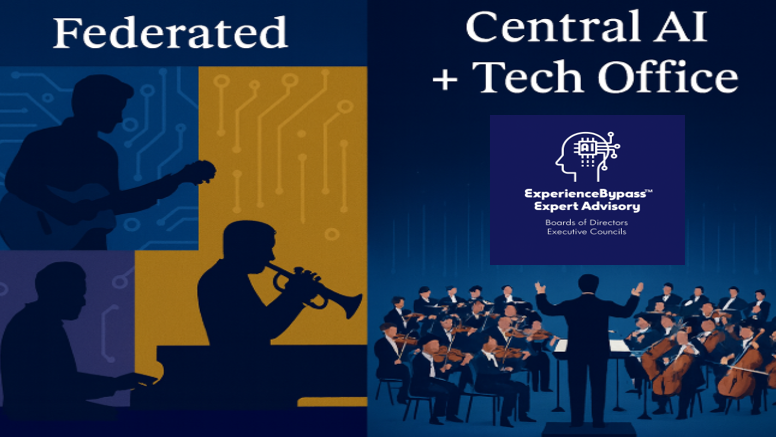
Once leadership architecture is clear, the enterprise needs a conductor, not more semi-independent musicians.
Having lived through these transformations before, my experience tells me tells me that the solution is a Central AI + Tech Office, led by a Chief AI & Technology Officer reporting directly to the CEO. That office unifies strategy, architecture, and execution, transforming fragmented titles into a single operating rhythm.
- CIO, CTO, and CDO act as deputies under defined RASCI boundaries.
- The CAIO integrates data, models, and outcomes, linking business and technology through a common playbook.
- The office defines and enforces the AI-ENABLED™ TOM, aligning governance, architecture, and business cadence across the enterprise.
This structure creates clarity of accountability and becomes the organizational precondition for transformation. There is clear direction, and most importantly single focused accountability.
Orchestrate the Enterprise — From Federation to Zero-Latency™
With leadership unified, the next challenge is how the enterprise performs.
In this “new” AI world, most companies still operate as federations, each business unit building independent AI pilots, hiring vendors, and optimizing locally. It feels fast but delivers limited enterprise lift.
“In a federated model, you have gifted musicians, guitarists, trumpeters, pianists, each performing local shows. It’s creative and quick, but it doesn’t fill the concert hall.”
The deeper issue is decision velocity. Federated structures depend on management by committee, alignment through meetings instead of design. And in an era where AI delivers commoditized wisdom in real time, that model collapses under its own latency.
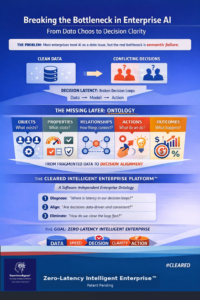
One of the defining characteristics of the AI-ENABLED™ TOM, and a cornerstone of CLEARED AI™, is Zero-Latency™ Decision-Making: the ability for data, models, and leadership intent to translate into enterprise action without delay. this will be the standard for an AI-Enabled™ Enterprise. As we know, that’s the opposite of management by committee. Federation breeds friction. Orchestration removes it.
In the AI-Enabled Enterprise Index™, federated organizations consistently plateau around 30 % AI enablement. Those that establish a Central AI + Tech Office scale far beyond that ceiling, turning local pilots into enterprise symphonies. While business units still execute locally, they play from one score, under a shared tempo and governance rhythm. That’s not bureaucracy, it’s structured agility: freedom inside coherence. If your Central AI organization is not demonstrating the ability to execute Zero-Latency Decisions™, it is the players and not the organizational structure.
From Solow to Symphony
The Solow Paradox proved that technology alone doesn’t drive productivity. AI is proving the same truth. Fragmented leadership and federated execution are two sides of the same coin. The cure is orchestration: one conductor, one score, one rhythm. Federation produces solos. Centralization produces symphonies.
To become an AI-Enabled™ Enterprise, start with structure: design your AI-ENABLED™ Target Operating Model (TOM), appoint your conductor, and orchestrate around Zero-Latency™ Decision-Making.
Only a symphony-grade operating model converts AI potential into measurable performance.
What is your situation? Are you in one of the “C” roles that basically reports to an AI committee? Comment and let me know about your experiences.
I am organizing a roundtable discussion on this topic, please let me know if you are interested in participating.
About the Author
Honorio Padron is a veteran technology and transformation leader with over five decades of experience across seven major global enterprises as CIO and CTO. He has also led extensive consulting engagements and successfully implemented AI-driven operating models across multiple industries.
He is the Founder of ExperienceBypass™, and the creator of the CLEARED AI™ Value Framework and the AI-Enabled Enterprise Index™—platforms that help organizations move from experimentation to orchestration and achieve Zero-Latency™ Decision-Making at enterprise scale.
Honorio’s work unites AI strategy, operational design, and leadership alignment into a single, measurable transformation model that accelerates enterprise performance in the age of intelligence.
👉 Follow for insights on AI leadership, transformation design, and operating-model innovation.