I recorded a short video above to frame this argument before getting into the details. The reason is simple: the current debate about AI agents versus enterprise platforms often misses the operational reality of running large, complex organizations.
This perspective is grounded in more than 45 years and multiple cycles of leading global enterprise transformations, operating large technology and process systems under real operational constraints.
There has been a surge of commentary claiming that AI agents will “eat” SaaS companies and enterprise platforms. The argument is straightforward: agents can reason, plan, and act autonomously, so the functionality embedded in traditional platforms will inevitably be absorbed and rendered obsolete.
This assertion deserves serious examination. When evaluated through the operational reality of running large enterprises, it does not hold.
Not because agents are weak. Because enterprise intelligence is not local. It is systemic.
The core misunderstanding
Most agent-centric arguments underestimate what actually constrains large enterprises. The problem is not a lack of intelligence at the edge. It is the ability to execute integrated decision loops at scale, repeatedly, safely, and with accountability.
This is the same dynamic I described in my work on the Architecture AI Bubble: markets flood enterprises with tools that create the illusion of progress while quietly increasing fragility, integration debt, and long-term operational drag. Agents risk becoming the next layer of that bubble if they are treated as a replacement for enterprise control planes rather than as participants within them.
Three realities are consistently ignored:
- G2000 enterprises operate decision loops, not isolated tasks
- Intelligence at scale depends on shared truth, not inferred meaning
- Autonomy without governance produces disorder, not speed
Agents matter. They do not replace platforms.
Decision loops define intelligence, not tools
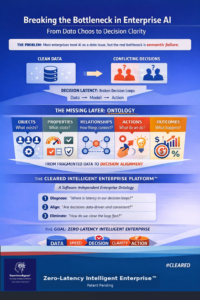
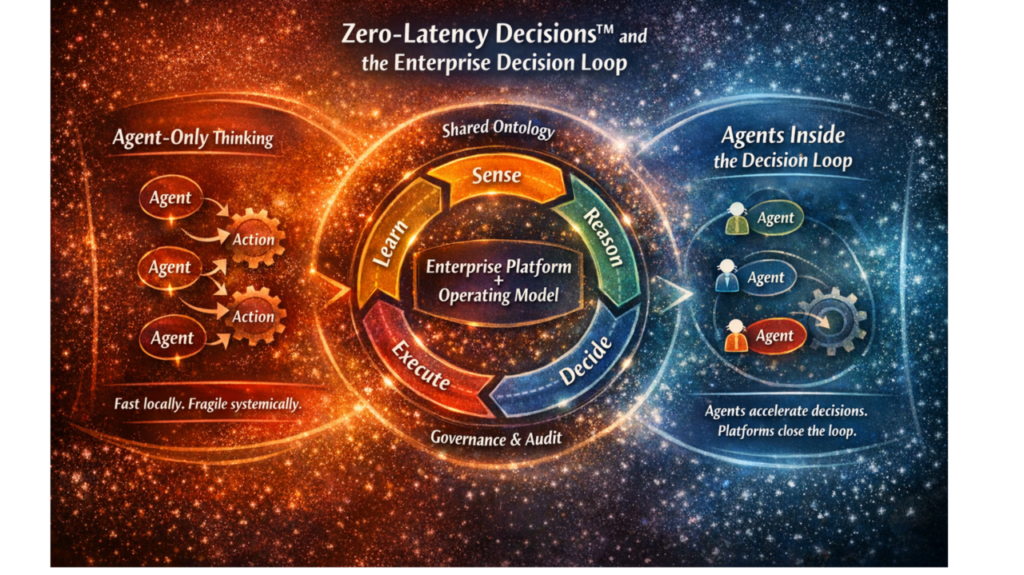
The Intelligent Enterprise is defined by its ability to execute end-to-end decision loops with minimal latency, high confidence, and full accountability.
A decision loop includes:
- Sensing across heterogeneous and distributed data sources
- Reasoning using shared business, operational, and decision semantics
- Selecting actions under financial, contractual, regulatory, and physical constraints
- Executing across systems of record and systems of action
- Observing outcomes and continuously learning
Zero-Latency Decisions™ are not about how fast an agent responds. They are about how fast the enterprise as a system can sense, decide, execute, and learn.
This is a direct manifestation of what I previously called the Slow Paradox of operating model evolution. The technology to support near-real-time decision loops has existed for years. What evolves slowly is the enterprise operating model required to trust, govern, and act on those decisions at scale.
Agents accelerate portions of the loop. Platforms are required to close it.
Where agents clearly help
Agents excel at localized autonomy. They are extremely effective when context is bounded and authority is explicit.
Examples include:
- A supply chain agent detecting a disruption and simulating mitigation options
- A maintenance agent predicting early equipment failure
- A finance agent flagging anomalous cash-flow behavior
- A customer agent resolving issues at scale
These capabilities materially reduce human latency.
But none of these agents own:
- The enterprise-wide data model
- The financial and contractual trade-offs
- The authority to execute across multiple systems
- The responsibility for audit, compliance, and learning
Without platforms, agents generate recommendations. With platforms, enterprises execute decisions.
This mirrors the DIY fallacy I have written about before. Enterprises should apply DIY effort to differentiating decision capabilities, not to rebuilding AI factory plumbing, integration layers, governance, or control mechanisms that have already been proven at scale.
Cross-enterprise decision loops expose the limit of agents
The limits of agent-only thinking become undeniable when decisions cross enterprise boundaries.
Consider a disruption at a Tier-2 supplier in a global manufacturing network. Responding effectively requires coordination across:
- Suppliers and logistics partners
- Manufacturing plants
- Finance and risk
- Sales commitments
- Regulatory and compliance constraints
This is a cross-enterprise decision loop.
Agents help by:
- Monitoring signals
- Simulating alternatives
- Proposing actions
But without:
- Centralized agent management
- Shared ontology
- Data virtualization
- Orchestrated execution
the system degrades into conflicting actions, inconsistent reasoning, and unacceptable risk.
Why agent management is mandatory
At G2000 scale, hundreds or thousands of agents will coexist.
Without platform-level agent management:
- Authority boundaries overlap
- Agents optimize conflicting objectives
- Execution order becomes undefined
- Accountability disappears
Agent management defines:
- Scope and authority
- Priority and escalation
- Conflict resolution
- Human override
- Deterministic execution semantics
This is not overhead. It is operational safety.
Ontology cannot be replaced by agent inference
A common counter-argument is that agents can dynamically infer meaning, eliminating the need for formal ontology.
This fails under enterprise conditions.
Ontology defines shared truth, including:
- What constitutes available inventory
- When demand is committed
- How capacity is measured
- How risk is evaluated
If meaning lives inside agents:
- Semantics drift over time
- Decisions become non-repeatable
- Audit and regulatory defensibility collapses
Enterprises must be able to answer a simple question: According to what definition did the system act?
Ontology must live outside agents, be versioned, governed, and auditable. Agents consume meaning. They must not own it.
Data virtualization is not plumbing
Another claim is that agents can fetch, reconcile, and reason over data dynamically, replacing virtualization layers.
At scale, this collapses due to:
- Latency explosions
- Unbounded system load
- Fragmented security and access control
- Endless reimplementation of integration logic
Data virtualization provides:
- Federated access without physical consolidation
- Unified logical views across enterprises
- Governance and sovereignty
- Real-time decision context
This is precisely how complexity becomes permanent when it is ignored. Hyperscalers promise completeness but require heavy assembly. Consultants monetize that assembly. Enterprises inherit systems only their builders can maintain. This dynamic was central to the Architecture AI Bubble, and agents do not break it.
Prediction 1: Evolution of SaaS and Enterprise Platforms in an Agentic World
Horizon: 1–2 Years
- Horizontal SaaS (ERP, CRM, HCM): Agent augmentation inside workflows
- Vertical SaaS: Embedded domain agents
- DIY AI Toolchains: Rapid experimentation
- Hyperscaler AI Stacks: Heavy build and integrate
- AI-Native Platforms: Underappreciated
Horizon: 3–5 Years
- Horizontal SaaS: Partial agent orchestration
- Vertical SaaS: Consolidation accelerates
- DIY AI Toolchains: Fatigue and cost pressure
- Hyperscaler AI Stacks: Growing pushback
- AI-Native Platforms: Accelerating adoption
Horizon: 5–10 Years
- Horizontal SaaS: Core systems remain, deeply agent-assisted
- Vertical SaaS: Survivors become intelligence hubs
- DIY AI Toolchains: Largely abandoned
- Hyperscaler AI Stacks: Used selectively, not control planes
- AI-Native Platforms: Default enterprise intelligence layer
Key takeaway: This is not about displacement. It is about which layer becomes the control plane for enterprise decision loops.
Prediction 2: Evolution of the Intelligent Enterprise Operating Model
Phase 1: Tool Tinkering
- Characteristics: Point solutions, pilots
- Outcome: Activity without impact
Phase 2: DIY Assembly
- Characteristics: Hyperscaler plumbing
- Outcome: Cost, fragility, complexity
Phase 3: Complexity Fatigue
- Characteristics: Maintenance overwhelms value
- Outcome: Executive frustration
Phase 4: Platform Realization
- Characteristics: Proven AI-native platforms
- Outcome: Focus on decisions, not plumbing
Phase 5: Sovereign Intelligence
- Characteristics: Internal control of decision loops
- Outcome: Mission-aligned execution
AI-native platforms with full AI Factory capabilities have existed for over a decade. What has been slow is operating model acceptance, not technology readiness. That is the Slow Paradox in action.
Why this shift is happening now
Enterprises are overwhelmed by:
- Tens of thousands of AI tools
- Hyperscalers claiming completeness while requiring massive integration
- Consulting ecosystems incentivized to preserve complexity
Executives are now demanding sovereignty.
Sovereignty means:
- Control over decision-critical capabilities
- Reduced dependency on fragile toolchains
- Focus on business mission rather than plumbing
Even Satya Nadella has acknowledged that much of today’s AI value accrues to AI creators rather than enterprises implementing AI. That is a clear signal that operating models, not models, are the bottleneck.
Final word to analysts and markets
This is a long transition. Not because the technology is immature, but because enterprise acceptance and operating model evolution take time. Markets expecting rapid displacement of platforms by agents are confusing capability with readiness.
Agents will not eat platforms. Platforms will become the governed control planes for agentic intelligence.
The enterprises that win will:
- Embed agents inside integrated decision loops
- Preserve shared truth through ontology
- Enable real-time execution through data virtualization
- Operate Zero-Latency Decisions with accountability
Agents accelerate decisions. Platforms make enterprises intelligent.
Closing callback
If you have read my previous pieces on the Architecture AI Bubble, the Slow Paradox of operating model evolution, or the limits of enterprise DIY, this argument should feel consistent rather than novel. The agent debate is simply the next surface where the same structural truths are reasserting themselves. Enterprises that recognize this early will compound intelligence. The rest will compound complexity.
Appendix: Anticipating the Hard Questions
The following Q&A addresses common counterarguments raised by enterprise architects, platform skeptics, and agent maximalists. It is provided as a reference, not as a continuation of the main argument.
Q&A Rebuttal Appendix
Q1: “If agents can reason end to end, why do we need enterprise platforms at all?”
Short answer: Because reasoning is not execution.
Enterprise decisions require:
- Shared semantics
- Coordinated authority
- Deterministic execution
- Auditability and accountability
Agents can reason. Platforms make decisions executable, repeatable, and defensible at scale.
Q2: “Why can’t agents manage themselves through peer coordination?”
Short answer: Peer coordination works in bounded systems. Enterprises are not bounded systems.
At scale:
- Objectives conflict by design
- Authority is hierarchical
- Risk tolerance varies by domain
- Accountability must be explicit
Self-organizing agents optimize locally. Enterprises must optimize systemically.
Q3: “Isn’t ontology just a legacy data-modeling concept?”
Short answer: No. Ontology is a decision contract.
Ontology defines what the enterprise means by:
- Inventory
- Capacity
- Commitment
- Risk
- Compliance
If meaning lives inside agents, it drifts. When meaning drifts, decisions cannot be defended.
Q4: “Modern agents can infer meaning dynamically. Why externalize it?”
Short answer: Inference is probabilistic. Enterprises require determinism.
Inference may work:
- In exploration
- In low-risk contexts
It fails when:
- Regulation applies
- Financial reporting is involved
- Decisions must be replayed years later
Inference is a capability. Governance is a requirement.
Q5: “Isn’t data virtualization just unnecessary middleware?”
Short answer: Only if you assume centralized data, trivial security, and no latency constraints.
In real enterprises, data virtualization exists to:
- Federate access without replication
- Enforce governance once
- Provide real-time decision context
- Preserve sovereignty across domains
Letting each agent handle data access recreates integration chaos at machine speed.
Q6: “Won’t hyperscalers abstract all of this eventually?”
Short answer: Hyperscalers abstract infrastructure, not enterprise accountability.
Enterprises still must:
- Assemble
- Integrate
- Govern
- Maintain
- Explain outcomes
That is how complexity migrates rather than disappears.
Q7: “Why not accept some chaos in exchange for speed?”
Short answer: Because chaos scales faster than value.
Over time:
- Errors compound
- Risk surfaces expand
- Trust erodes
- Systems slow under corrective overhead
Zero-Latency Decisions™ require confidence, not just speed.
Q8: “Aren’t platforms just slowing innovation?”
Short answer: Poor platforms slow innovation. Coherent platforms enable it.
Platforms that provide:
- Shared truth
- Integrated decision loops
- Governed autonomy
increase the safe surface area for agents to operate.
Q9: “Why emphasize operating models so much? Isn’t this a tech problem?”
Short answer: Because the technology arrived before the operating model.
AI-native platforms have existed for over a decade. What lagged was:
- Executive trust
- Governance maturity
- Willingness to abandon DIY complexity
This is the Slow Paradox in action.
Q10: “So what actually changes with agents?”
Short answer: The execution layer becomes autonomous.
What does not change:
- The need for integrated decision loops
- The requirement for shared truth
- The necessity of governance
- The demand for accountability
Agents change how work happens inside the loop. They do not replace the loop.
Q11: “Who benefits if platforms remain central?”
Short answer: Enterprises do.
As executives push for sovereignty, value shifts back to organizations that control their decision loops rather than rent intelligence piecemeal.
Q12: “What is the single mistake critics are making?”
Short answer: Confusing autonomy with intelligence.
Intelligence at enterprise scale emerges from:
- Integration
- Coherence
- Control
- Learning over time
Agents provide autonomy. Platforms provide intelligence.
Final note for critics
This is not an argument against agents. It is an argument against mistaking local capability for systemic readiness.
Enterprises do not fail because they lack tools. They fail because they lack coherent decision execution.
That is what platforms exist to solve.
Please get in touch with me at
Honorio@ExperienceBypass.com