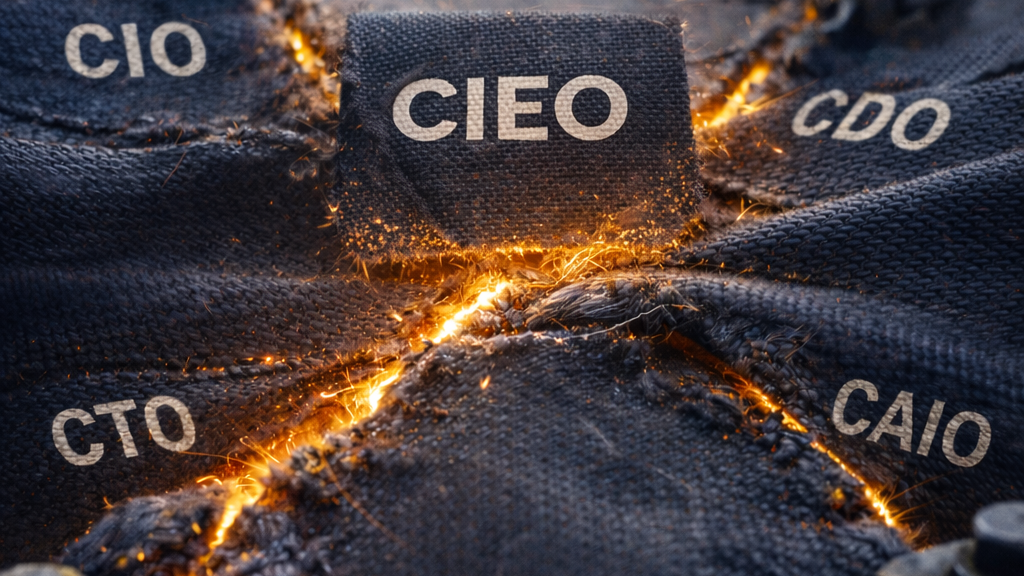
By 9:45, the room is still debating who owns customer data quality. The CIO says it’s a system integration issue. The CDO says it’s a data governance problem. The CAIO says the models cannot learn from dirty data. The CTO says the API should never have accepted bad inputs.
By 10:30, they agree to form a working group.
Meanwhile, a customer cancellation propagates across demand forecasting, inventory optimization, supply chain rebalancing, predictive maintenance, and robotic fulfillment in under 200 milliseconds.
That gap in speed is killing enterprises.
This is not a technology failure. It is a leadership and operating model failure.
The enterprise crossed a threshold, but the org chart didn’t.
Decision velocity is existential. Delays no longer just cost money. They cascade across operations, supply chains, and cash flow. Latency destroys value faster than inefficiency ever did.
Automation and robotics now execute decisions directly. There is no human buffer. When intelligence updates, machines act. Digital decisions now have physical consequences.
Learning is continuous. Enterprises no longer plan, execute, and review in phases. They sense, decide, act, and learn continuously across the value chain.
Together, these shifts turn the enterprise into a continuous decision system. Most leadership models were designed for a very different world.
Why separation used to work, and why it no longer does.
Historically, separation made sense. IT built and ran systems. Data explained the past. AI recommended actions. Operations executed. Leaders coordinated across domains.
That model works when intelligence is advisory, and execution is human.
It breaks the moment intelligence acts.
You cannot coordinate at machine speed. You cannot govern milliseconds with meetings.
Alphabet soup is a rational response, and the wrong end state.
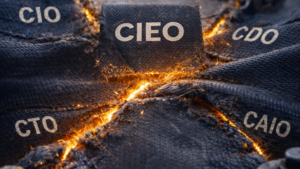
As pressure mounted, organizations responded logically by adding roles: CIO, CTO, CDO, CAIO. Each role addressed a real and growing need. Together, they fragmented accountability.
What actually happens in practice: Multiple data strategies running in parallel. Overlapping technology roadmaps. Architectural tradeoffs escalated instead of resolved. Pilots are multiplying while production impact stalls.
This is not a coordination failure. Coordination is the failure mode.
A simple test: who owns the decision loop?
Consider a manufacturer committing to customer demand. That single commitment triggers AI forecasting, inventory optimization, supply network rebalancing, predictive maintenance, robotic fulfillment, and billing and cash flow updates.
This happens in seconds.
Now ask one question: Who owns that loop end-to-end?
If the answer is “they coordinate,” the enterprise is already too slow. The decision was executed before the meeting invite was sent.
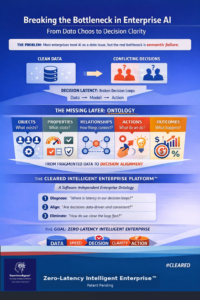
This is not a collection of systems. It is one integrated decision loop.
Necessary clarification about CIOs.
In any large enterprise operating competitively today, the CIO is rarely a narrow “keep-the-lights-on” executive. Organizations of scale do not survive that way.
Most modern CIOs already: Understand the business deeply. Shape process and decision architecture, not just systems. Balance stability with change. Operate across applications, data, and infrastructure. Absorb AI and automation into their remit because nobody else can make it work.
In other words, many CIOs are already doing the work this article describes—even if the title has not caught up. This is not an indictment of CIOs. It is an indictment of outdated role definitions.
The same structural truth applies to CDOs.
The CDO role emerged for good reasons. Data quality, governance, and analytics mattered.
In a reporting-driven enterprise, separating data leadership was survivable.
In an intelligent enterprise, data is no longer explanatory. It is execution fuel.
Data semantics are decision semantics. Latency matters. Tradeoffs between cleanliness, speed, and learning must be made continuously. Those tradeoffs cannot be made outside the systems that execute decisions.
This does not diminish data leadership. It means data leadership cannot be independent of execution accountability.
And it applies equally to CAIOs.
The CAIO role exists because AI is complex, fast-moving, and specialized. That specialization is real and necessary.
What fails is positioning AI as a parallel authority.
The hardest AI decisions are not about models. They are about where models execute, how they integrate with ERP and OT systems, how failures are handled safely, and how learning loops are closed in production.
Expertise without ownership creates pilots. Ownership without integration creates risk.
Where consultants unintentionally make the problem worse.
Much of the enthusiasm for proliferating new C-level titles has been encouraged by advisors who have never had to run an intelligent system in production.
From the outside, adding a Chief Data Officer or Chief AI Officer looks like progress. It signals intent. It produces strategy decks, roadmaps, and pilots.
From the inside, it often produces more handoffs, more coordination, more architectural ambiguity, and more pilots that never scale.
This is not malice. It is perspective.
If you have never been accountable for a system that had to work at 3 AM, move physical assets, stop production lines, or explain a failure to a CEO in real time, fragmentation looks manageable. Coordination feels safe.
If you have lived that reality, you know better. You know pilots fail at scale because nobody owns the seams, and “alignment” becomes the tax paid for avoiding leadership decisions.
This is how organizations become rich in experimentation and poor in outcomes.
What the enterprise actually needs.
The intelligent enterprise needs one accountable owner of the operating system. Not a coordinator. An owner.
One executive accountable for technology architecture, data semantics, AI in production, automation and robotics, IT and OT convergence, and integrated Design–Build–Run execution.
Someone who can say: “I own the entire loop. If it fails at 3 AM, it’s my failure.”
They do not do everything. They are accountable for everything.
About titles.
Some organizations call this role the Chief Intelligent Enterprise Officer. Others evolve the CIO role to absorb this scope.
The title is secondary. Clarity of accountability is not.
Experience makes the conclusion unavoidable.
I’ve spent decades operating on both sides of this equation, as a CIO and as a CTO, with responsibility spanning IT, OT, and increasingly AI-driven systems. I’ve lived inside enterprises where decisions moved money, inventory, and physical assets in real time, and where failures did not wait for governance forums or steering committees.
That experience teaches a simple lesson.
AI works and can scale. Automation scales. Robotics executes.
What consistently fails is fragmented ownership.
When no one owns the seams between data quality, model behavior, system integration, and operational execution, the enterprise slows itself down. Not because people are incapable, but because the operating model was never designed for intelligence that acts continuously.
I’ve seen organizations try to solve this by adding roles, creating councils, and celebrating new titles. The result is almost always the same: impressive experimentation, fragile production systems, and pilots that never scale.
I’ve also experienced what happens when one leader is clearly accountable for the whole operating system. Decisions get made. Tradeoffs get owned. Systems learn while running. The enterprise moves at the speed its technology actually allows.
That is why this is not a debate about titles, personalities, or power. It is a recognition of how modern enterprises actually operate.
When intelligence executes continuously, leadership must be integrated.
You cannot run a continuous decision system with episodic leadership. You cannot execute at machine speed with coordination latency. You cannot scale AI, automation, and robotics without a single owner of Design–Build–Run.
At some point, every enterprise reaches the same conclusion: The Intelligent Enterprise requires one accountable owner.
In many large organizations, that person is already the CIO in practice. The work now is to formalize the role, align authority with accountability, and stop fragmenting what has already converged.
The only real choice left is whether that recognition comes deliberately or after a faster competitor forces it.